
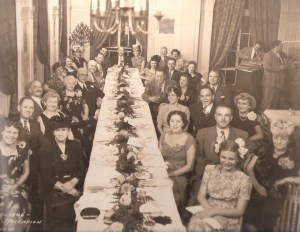
New York City, 1946. A family gathers at the Castleholm Restaurant to celebrate a 70th birthday. They are all there, everyone who has immigrated from Bavaria, Germany since the early 1900s. In less than a half century, they have started new lives and founded thriving butcher shops, bakeries, millinery and couture dressmakers shops, as well as well-known restaurants.
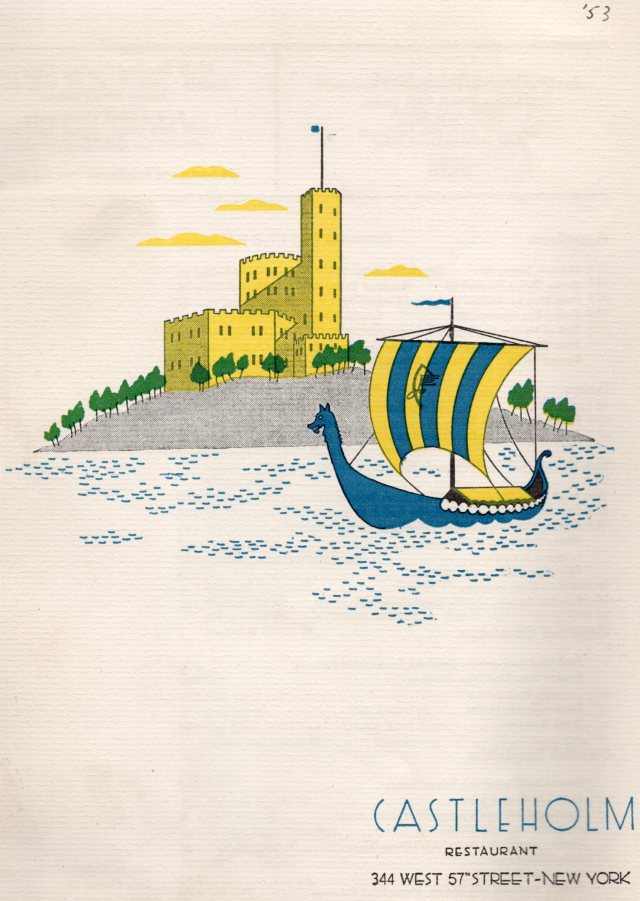
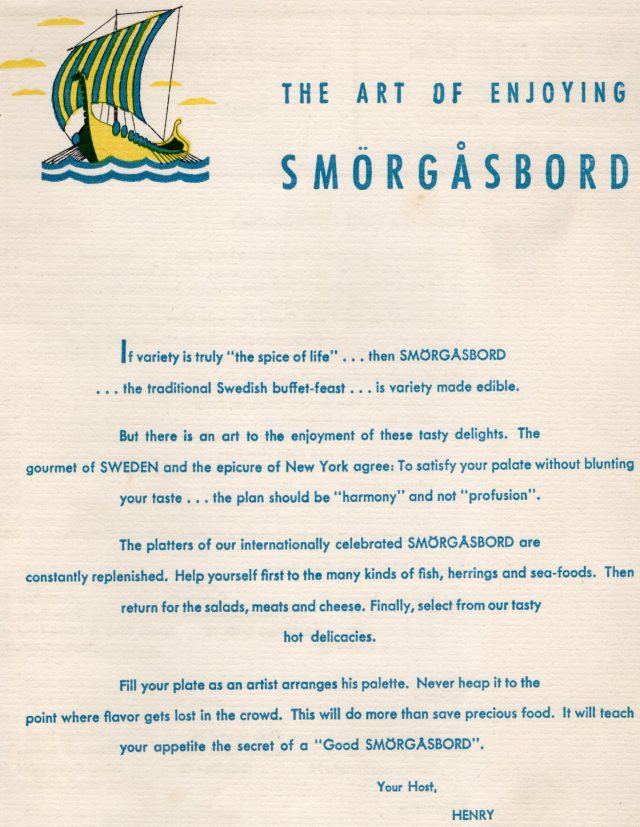
Most are from a family of eleven children, the eldest siblings coming to the U.S. after World War I. The oldest brother finds success in the hospitality industry, eventually opening the unique Castleholm Swedish Restaurant. The grand Viking dining room becomes the gathering place to celebrate hallmark life events, all documented with photo portraits showing elegant groups of thriving people, photos duly mailed back to family overseas. Copies hung in houses on both sides of the Atlantic, hand-written notes inked on the back to make sure the recipient knew who everyone in the picture was.
As a child, I saw these duplicate images proudly displayed by great-aunts and great-uncles, here and abroad. Whether or not I had actually met the people in the photos in my own lifetime, I most definitely, visually, knew all of them. The Castleholm photos became a roadmap to guide family storytelling, stories often repeated in both languages. More often than not the Castleholm Restaurant played a major character role, becoming part of family legend and lore. My great-uncle Henry was the co-owner and manager; his wife, Aunt Erna, the hostess. They lived above the ground-floor restaurant in the same pre-war apartment building. Because the restaurant was close to Carnegie Hall, tales often featured the great performers of the day. These stories were told so many times they rolled over you as a matter of course, settling into your bones and becoming part of your DNA.
New York City, 2006: After aspiring to live and work in New York City, I land a position running a national medical association in mid-town Manhattan. But the organization is going through a turn-around period and signing an apartment lease has to wait. I bounce between a friend’s sofa, stale hotel rooms, and hard train seats on a two-hour train commute to stay with family. In-town board meetings become late-night marathons, and the transiency wears me out. So it is with gratitude and relief that I accept a board member’s offer to use her vacant studio apartment as a place to land.
I take the key she hands me at the end of the latest board meeting, scribble down the address, and hop into a taxi with no expectations other than, finally, having a room of my own. I call my mother to let her know my accommodations are set for the evening. “Give me the address where you are staying,” she asks sleepily.
I check my handwriting in the dim backseat light: “344 West 57th Street.”
My mother catches her breath, suddenly awake. “What was that address?”
I repeat, “344 West 57th Street.”
There is an odd sound to her voice as she responds, “Do you know where you are going?”
Annoyed with the question as a perceived reference to my habit of confusing uptown and downtown, I retort, “Of course I know where I’m going. I’m on the West Side, we just passed Carnegie Hall, I’m staying at Maria’s apartment.”
“That’s not what I meant. Do you know what’s at that address?”
Too tired for circular conversations, I simply ask, “No, Mom. What am I supposed to know about that address?”
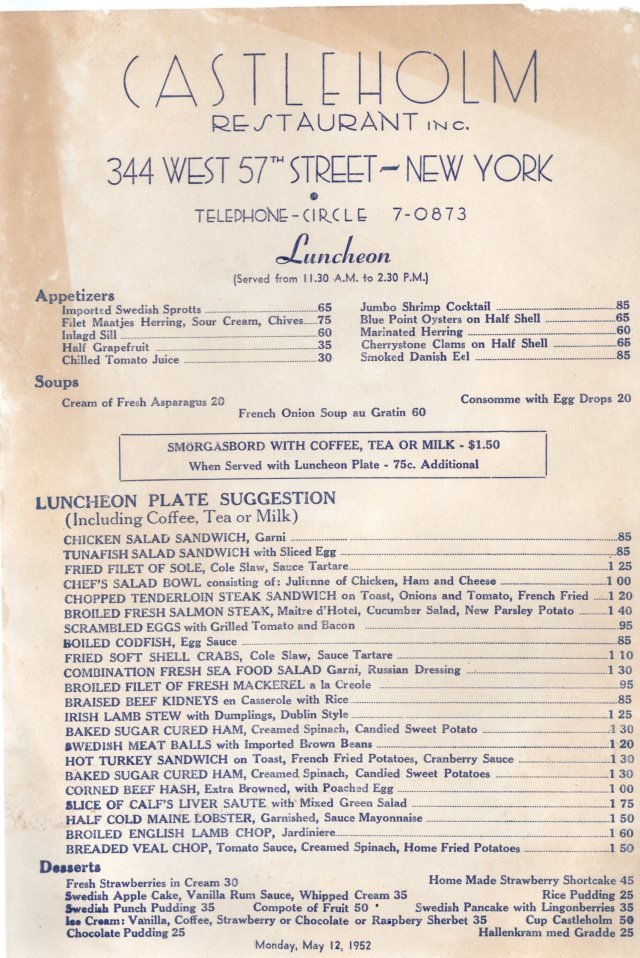
“That’s where the Castleholm Restaurant used to be.”
Now it’s my turn to catch my breath. Despite all of the stories, I had never known the restaurant’s actual address. Out of all the buildings on the island of Manhattan…for my first night living on my own in New York City, my family had brought me home.

 Echoes
Such a great story…and of a special synchronicity! Our ancestors and heritage connect us to one another through the stories, and through places. Preserving those stories gives meaning to the past in the present!